The Dark Knight (Christopher Nolan, 2008): USA
Reviewed by Dong-Hwan Kim. Viewed on DVD.
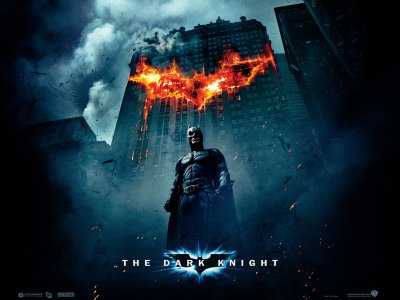 (This could be an analysis, rather than a review. So be patient!)
Let’s say there is a man on a boat, and there is an airplane filled with people who have a fatal contagious disease, as well as his lover. If the plane lands many people are going to die. But the man has a rocket to take it down. What will be his choice? If he decides to take it down, are people going to treat him like a savior or a criminal? How worthwhile is it to maintain justice? What does it take to be a hero? What is the difference between a hero and a villain? Christopher Nolan throws endless questions related to human being’s fragility and duality through several characters to define this elusive concept of being hero.
The reason why this film is different from Tim Burton or Joel Schumacher’s Batman films is that those directors choose the simple composition of absolute good versus evil, whereas Nolan chooses man versus man. This distinction makes the film more realistic than the previous ones. Of course, Batman and Joker in this film also represent good and evil, but they share something in common; they are also humans. Both characters are the creation of modern society, symbolized through Gotham as wealth, poverty and crime. Each character chose different paths, but the contexts behind their new identities are the same. Batman is armed with unimaginable wealth and high technology, and Joker is armed with unstoppable madness. Joker does not simply represent madness. Based on his mental state and his actions, he takes essential human pleasure in violence. He does not want money or power, but chaos.
Whereas Joker has already reached his extremity of madness, Batman hasn’t reached yet what he is trying to achieve; justice. In one scene, Batman fails to kill Joker while he has the perfect chance. It is hard to understand why he misses the opportunity. Why doesn’t Batman, who has a sense of duty, justice and powerful weapons, take the chance to kill Joker? He is not constrained by any law and nobody knows who he is. So Batman should have no problem at all killing Joker. But Bruce Wayne, not Batman, cannot accept this action. It is not because he feels a sense of guilt, but because when answering the question of whether is it right to achieve justice by killing someone, Bruce Wayne, as a human being, concludes it is not.
In the middle of this exchange, Harvey Dent emerges as a new hero of Gotham. But what is the difference between an admired hero who exposes himself to the public and a cursed hero who does not expose himself at all? In fact, the latter is an outlaw. Batman frequently destroys people’s property, including police property. Humans in modern society generally define outlaws or criminals as people who violate the law. Batman could potentially be considered an exception for what he does for the public, but the reality is cruel. People want Batman to do his job while not harming citizens or property. But Harvey is different. He executes his plan within the limitations of the law and never harms anyone. For both the white knight and the dark knight, their differences in method create a huge difference between them, even though the result is same.
No human being is always perfect. That is why people, unconsciously or consciously, depend on one another. These three characters, Batman, Joker, and Harvey, do the same thing. They form a symbiotic relationship to one another. The reason why Harvey can be Harvey is because Batman and Joker are out there, violating the law. Similarly, Batman can be Batman because Joker is pushing him to catch him. In the middle of the film, Joker says to Batman, “You complete me.” Batman thought Joker tried to kill him, but people like Harvey and Batman are the only reason he exists. He is nothing if no one is trying to catch him. Furthermore, Joker succeeds in his plan to bring Harvey down to his level because Joker, who symbolizes chaos, finds pleasure in that occurrence. Perhaps, it is because he wants Batman to be more stimulated to play with him. At the end, he says, “And I won’t kill you because you are just too much fun.” It is particularly interesting to notice the cinematography in this scene. The camera catches Batman in a normal medium shot, but Joker is upside down, like he is watching the world through a different perspective. But the shot of Joker gradually rotates to match Batman’s shot. This scene implies they eventually live in the same world, regardless of how different they are. Ironically, while Batman does complete Joker, Joker also completes Batman by perfectly deceiving Batman to rescue Harvey rather than Rachael.
At this point, Batman becomes the real Batman, not the Batman who only fights against crime. Batman was born through Bruce’s personal reasons in response to his parents’ deaths, but through painful agony he finally becomes the Dark Knight. He now has a noble cause, a duty for the city of Gotham. As an example, is the case of Coleman, who tries to disclose Batman’s identity but later becomes the number one target in the city. Who would try to save someone who was going to harm him? There is no more personal reason or cause for Batman. Once he becomes part of Joker’s level, he transcends the reason he once had.
Another example of a transitioning character is Harvey, who was once a hero. As apparent from his new name and face, duality becomes the keyword for his life. He could also simply be considered the perfect mixture of Batman and Joker. He leaves the fate of traitors up to the duality of his coin. Perhaps, he wants either of them to come and kill him; it does not matter who. There is no reason for him to live after he finishes his revenge. Batman chooses to do this job for Harvey. Just as Harvey took the risk to give himself up as Batman because he knew how important the idea of Batman was to the city of Gotham, Batman knows how important a symbol Harvey is for Gotham. Therefore, he risks becoming the public enemy to preserve Harvey’s legacy, while carrying Two Face’s burden. This is how Batman becomes the true hero.
This film poses for a different hero movie because so many humanistic values underlie this film. Here, a hero is not simply a born-hero or a biologically engineered mutant. “The Dark Knight” shows how the true hero is born when he applies human characteristics to his life.
32 Comments
Jump to comment form | comments rss [?] | trackback uri [?]