Hamnet (Chloé Zhao, 2025): United Kingdom | United States
Reviewed by Hanna Ward. Viewed at the SBIFF.
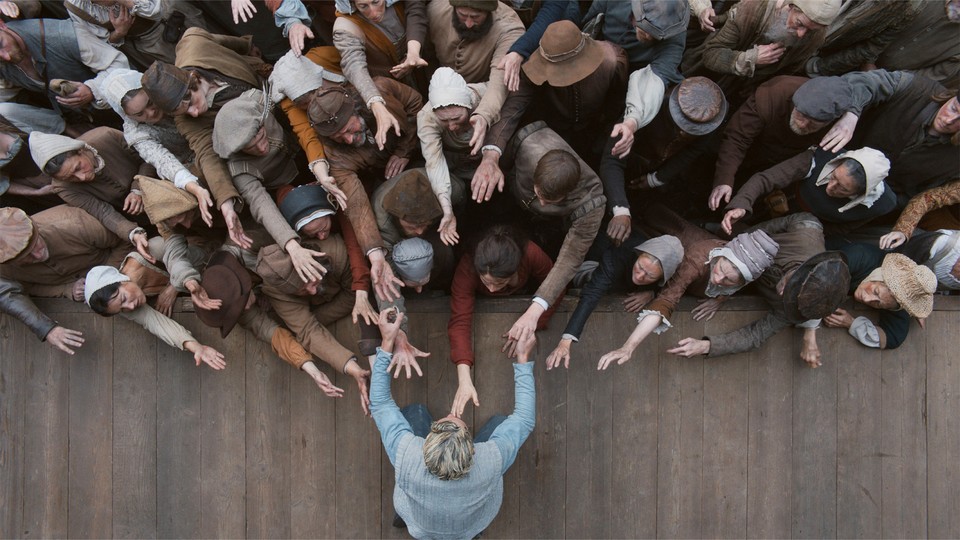 Nomadland director, Chloé Zhao, has returned to the Academy’s radar with her film, Hamnet, receiving eight total Oscar nominations — including Best Picture of 2026. During my time with the SBIFF, I have attended almost every Best Picture nominee screening at the Arlington Theater, and Hamnet was one of them. When I first arrived at the theater I was met with one of the longest lines I have ever seen at a cinema, and was worried I wouldn’t be able to make it inside; my patience did prevail, and I am ambivalent to whether it was a single bit worth it in the end.
Zhao and Maggie O’Farrel’s screenwriting was dramatically aided by performances from Jessie Buckley and Jacobi Jupe — not so much Paul Mescal — who play the mother and son known as Agnes and Hamnet. Buckley is raw and guttural with her acting, portraying resentment in almost an animalistic character of its own, while Jupe portrays the innocence of young, growing, life being crushed by responsibility larger than itself with amazing emotional agility and strength. Mescal, on the other hand, is the tortured artist that is William Shakespeare, whose performance doesn’t go further than a depressive shell, covering the true vulnerability of a man using his grief as a means for the creation of his commonly believed magnum opus, Hamlet.
A quote is the first thing we see from this film, one clarifying that Hamnet and Hamlet were interchangeable names during the 16th and 17th centuries, as a celestial harmony plays and continues to play past a hard cut to a low angle shot of a tree’s branches, slowly panning to below where Agnes lays, fetally curled along its thick roots. The audience learns as she wakes up that she has some sort of connection to nature, or deep understanding seen by her ability to call upon a hawk to land on her arm. The scenery changes to a dim lit building, where William takes his place as seemingly rehearsing lines with a group of children; his attention shifts when he spots through a window, Agnes with her signature colored red and hawk companion, to which he chooses to follow her into a shed, his curiosity apparently unquenchable. Their love story begins in this moment, when Agnes declines sharing her name followed by William essentially asking for a kiss, their hands slotting together, and her declaration that he cannot see her again. What follows shortly after this sequence, is of course, them meeting again in the forest and sharing a kiss, later a sex scene, and even later, the birth of their first child together.
Of all of these moments, by far the most interesting (which it wasn’t particularly that interesting overall) is Agnes’s labor, where she frantically makes her way into the forest to give birth, the wind’s roaring, birds chirping, and branches swaying periodically growing louder each time she groans in agony, all captured in an isolating long shot. Mid yell, another hard cut is applied, inserting a black screen and a moment of silence before we see the birth was successful as Agnes holds her child. I’ve never seen a birth scene quite like this one before, but that isn’t exactly a feat when the scene also feels underwhelming in its execution. What we as an audience are supposed to understand during this scene is Agnes’s bond to nature; it representing humanity’s unbreakable tie to the spiritual force within it, that protects and heals us. What the audience actually sees is a moment that feels like it should mean something beyond its surface level, but is lost in its own visual and auditory imagery, as well as the applied distance from Agnes, which fails to translate the symbolism properly. While Buckley manages to carry this scene on her heaving back, her yell acting as a glimpse into the tone of the later parts of the film, the integration of nature as its own character falls flat and is all in all disorienting of the film’s goal — unfortunately, this distracting effort from the first act becomes a pattern that bleeds into the second and third acts of the film as well.
While reflecting on the whole of the film and the specific parts I found enjoyable, Mescal’s performance does not center any of them. In fact most scenes aren’t entirely memorable when I remove Buckley, as well as Jupe, from them. This became particularly apparent during the second act of the film, which follows the birth of the Shakespeare twins; their birth as well as raising meant to grab and hold your heartstrings while the film proudly prepares to showcase the tragedy it’s based upon — the death of Hamnet — and wrench them out of your being. Hamnet’s death scene is by far the most memorable to me, as Jupe’s acting is so moving that it almost makes me forget about the manicured attempts for a collective sob session, and excessive pointing to moments requiring sympathy, that follow after. For a film that is centered around emotional expression and acceptance, it truly never appeared to believe in its audience’s ability to feel on their own, nor did it ever appear to accept itself as being devoid of the emotion it was trying to convey. Moreover, the exploration of grief and the multiple ways grief can show up in our lives was interesting to hear about, but experiencing the execution felt shallow and a lot left for the imagination, due to this theme only ever being of focus in the final scene of Hamnet. During this final scene, Hamnet’s limbo is resolved through William’s presentation of his play Hamlet, that Agnes and her brother attend after a substantial period of separation from him. At first, Agnes makes an entire fool of herself (a moment where Buckley’s acting is overdone I will say) but in a moment of realization, she calls upon the idea that she is witnessing the spirit of her son on the stage, causing both her resentful grief to dissolve and her understanding of her husband to grow, finally realizing that grief should never be felt alone — it is something that is shared, seen through the crowds resonance with Shakespeare’s art despite not having endured his, along with Agnes’s, same pain.
A lot of my experience with this film felt like a constant prying for the substance that it’s telling me is there but failing to show, which quickly became exhausting as it registered to me that the film was just never going to go beyond its general interpretations and aesthetically pleasing cinematography. If I were to ignore Zhao’s orchestrated emotional cues implemented purely for award show buzz, I’m sure I would have enjoyed this just a tad more — but not much — as even without the deliberate attempts at sob-bait, the film does not have much going for it beyond impressive performances by two actors and nice, but conventional, visuals.
About this entry
You’re currently reading “Hamnet (Chloé Zhao, 2025): United Kingdom | United States,” an entry on Student Film Reviews
- Published:
- 02.24.26 / 10am
- Category:
- Films, Santa Barbara Film Festival 2026
6 Comments
Jump to comment form | comments rss [?]